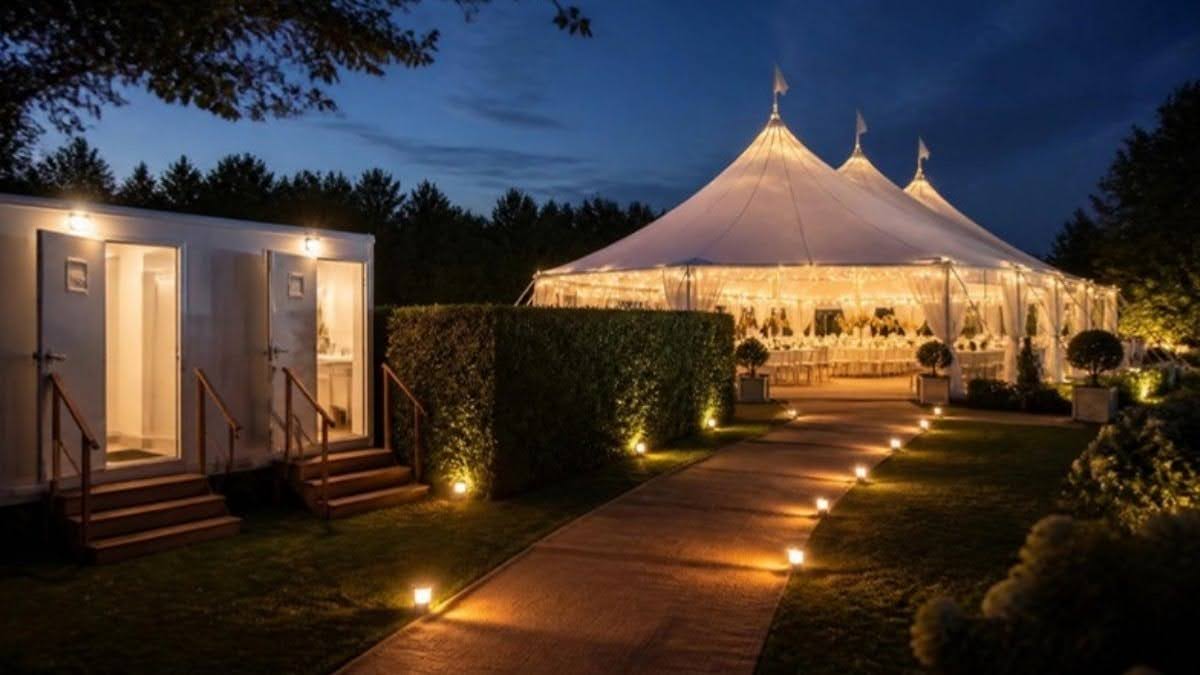
Where to Place a Restroom Trailer at a Tented Gala or Event
Knowing where to place a restroom trailer at a tented gala or event can be tricky. It needs to be close by, but you don’t want restroom facilities getting in the way of everything else, including your lighting, access, and power.
Fortunately, VIP To Go has been in the restroom trailer business since 1998. In this guide, we explain where to place your trailer so you can finalize your layout with confidence and give guests at your holiday gala the best possible experience, even in cold weather.
Begin with Your Site Plan
Our first piece of advice is to start with your site plan. Choose where your tented event restroom trailer will go when you place your tent. We strongly recommend against squeezing it in afterward, since restroom trailers need space around them and access for the delivery truck.
Every spot you consider should meet a few basic requirements:
- Level, dry ground: Avoid mud and marshy areas. Soft ground can collect water, cause the trailer to sink, and make it harder for guests to reach.
- Truck access: We deliver every trailer by truck, so the spot needs a clear route in. Multi-day events also need access for servicing, when we empty waste tanks and restock paper supplies.
- Dedicated power: Restroom trailers need electricity for climate control, water pumps, and lighting, and they need circuits of their own. A trailer that shares a circuit with catering equipment or the band’s amps can trip the breaker.
- Water: Trailers connect to a standard garden hose or run from an onboard fresh water tank that we refill on a servicing schedule.
Our restroom trailer site requirements guide covers the power, water, and access specs in detail, and our rental info page explains how bookings work. You can also call our team for a free site walkthrough to find the easiest setup for your event or gala this winter.
Place the Trailer Close to the Tent
We suggest placing your restroom trailer close to your tent or covered area. Guests in formal shoes shouldn’t have to cover much ground, especially over damp or muddy terrain.
In general, connect the trailer to the tent with a proper walkway, especially in the cooler winter months when conditions underfoot are more likely to be poor. Don’t push the trailer right up against the tent, though. It can feel cramped, and plumbing noise can carry into your event space.
Here are a few principles we use when planning restroom trailer placement:
- Place the trailer near a secondary tent entrance, not the main entrance.
- Think about where lines will form. They usually build up after dinner, when demand for the restroom is highest, so make sure they won’t block key access points or get in the way of catering staff.
- Leave space between the trailer and the tent so guests can walk comfortably without tripping over guy lines or stakes.
For larger events, we suggest using two or more restroom trailers. Placing one on each side of the main tent shortens the walk for guests and spreads out foot traffic.
Not sure what size you need? Our restroom trailer rental guide and the full lineup of restroom trailers can help you compare options, from compact two-station trailers to ten-station models for large events.
Plan Generator Placement Carefully
Some sites need a generator to power the trailer’s lights, pumps, and climate control when no suitable power hookup is available. This is more common than you might think, since many galas and events take place at remote venues.
Generators come with their own placement requirements. They take up space and emit carbon monoxide exhaust, so set them well away from guests and staff.
Generators also make noise, so keep them well away from the stage, the band, the head table, and anywhere people will be giving speeches.
Check the likely wind direction for the day of the event, too. Ideally, the wind will carry noise and fumes away from your guests. With proper placement, a generator’s hum can be barely noticeable.
Fire codes also apply. The International Fire Code, which many jurisdictions adopt, requires generators to be at least 20 feet from tents and separated from the public by fencing or another approved barrier. Local requirements can vary, so check with your local fire marshal or permitting office, and talk with our team about the best spot for your site.
Light the Walkway
Lighting the walkway between your tent and restroom trailer is essential. Exterior lighting reduces the risk of trips, slips, and falls, and it’s especially helpful in wet, cold, or muddy conditions.
LED lighting makes this easier than ever. You can light walkways with low, warm, even lighting along their entire length using lanterns, string lights on posts, or ground-level path lights.
Be careful not to overdo it, though. Too-cool or too-bright lights can dazzle guests and work against you. Laying an outdoor runner or carpet, especially over grass, will also help keep everyone steady and protect the ground.
Plan Your ADA Route
Next, plan an accessible route to your restroom trailers. The 2010 ADA Standards for Accessible Design require accessible routes to be at least 36 inches wide, with a firm, stable, slip-resistant surface and a running slope no steeper than 1:20.
Any part of the route steeper than 1:20 is treated as a ramp, which has its own requirements, including handrails on ramps that rise more than 6 inches. Also keep loose gravel and deep grass off the route. Requirements for temporary events can vary, so confirm what applies to your venue.
These requirements can make ADA restroom trailers a little trickier to place. We suggest putting them in the location with the shortest, flattest route from the main tent, so guests can reach them along a wide, well-lit path. For more, see our guide to ADA compliance for restroom trailers.
Check Sightlines
When placing a restroom trailer at a gala or event, check sightlines, too. Guests and photographers will want photos without restroom facilities in the background, especially if you’re setting up a restroom trailer for a tented wedding. Stand at key spots around the venue as if you were the photographer and check whether the trailer will be visible. In most cases it won’t be, but it’s worth a quick look.
Exterior shots are the riskiest. Many photographers like to capture long-exposure images of a glowing tent against a dark sky, so place trailers behind a row of hedges or at the rear of the tent where they won’t interfere with those shots.
Leave Room for Vendors and Catering
Make sure vendors and caterers still have plenty of room to reach the site. Bar staff, rental companies, florists, and bands all need access for their equipment and vehicles.
Keep restroom trailers away from food prep areas and catering routes, and avoid placing them where vendors will be moving equipment through areas where restroom lines are likely to form.
When to Tent the Entrance to a Restroom Trailer
Sometimes it makes sense to tent the entrance to a restroom trailer with a small tent or canopy.
For example, we suggest tenting the entrance when the weather is uncertain, since nobody wants to wait in line in the rain. A canopy can also help when the walk is longer than ideal. In some layouts, you can run a covered walkway from the main tent’s exit to the trailer’s entrance.
At large galas, lines often form outside, and a tent helps keep guests out of the wind and cold while they wait.
If you’re planning to tent the entrance, talk to us first so we can review your layout and tent placement. Keep any added tents or canopies at least the required distance from generators, too.
Get Help from VIP To Go
Placing restroom trailers can be challenging, especially at galas and events with limited space. Our team is here to help. We offer a free site walkthrough to review the grounds, access, and layout, then recommend the best placement for your restroom trailers. Contact us or call (877) 564-6977 to get started.